Fibermaxxing: How Much Fiber Do You Really Need?
Fibermaxxing is everywhere, but more fiber isn't always better. Learn realistic daily targets, the best food sources, and how to increase intake without digestive discomfort.

A bowl of oats, chia seeds, berries and bran might look like an ordinary breakfast. On social media, it can become a challenge: how many grams of fiber can you fit into a single meal? That is the spirit of “fibermaxxing,” a nutrition trend built around deliberately increasing fiber intake.
On this page
- What is fibermaxxing, exactly?
- How much fiber do adults actually need?
- Why fiber matters beyond digestion
- Regularity and digestive comfort
- Cholesterol, blood sugar and the bigger dietary pattern
- A varied food supply for the gut
- Soluble versus insoluble fiber: do you need both?
- Can you eat too much fiber?
- Who should be cautious before adding a lot of fiber?
- A practical way to increase fiber without making every meal a project
- 1. Start with the meals you already eat
- 2. Change one or two things—not everything
- 3. Drink fluids regularly
- 4. Build from familiar foods
- 5. Notice consistency, not perfection
- What a higher-fiber day could look like
- Do fiber supplements count?
- Common questions about fibermaxxing
- Is 50 grams of fiber a day healthier than 28 grams?
- Will fibermaxxing make you lose weight?
- Can high fiber cause constipation?
- Are beans better than fiber gummies?
- The takeaway: try fiber-meeting before fibermaxxing
- Sources and further reading
The underlying idea is sensible. Many Americans eat less fiber than recommended, and fiber-rich foods are a valuable part of a balanced diet. The catch is the word “maxxing.” There is no evidence-based contest to consume the most fiber, and jumping from a low-fiber diet to an enormous serving can make an otherwise healthy habit uncomfortable.
So how much fiber per day is enough? For many adults, the right goal is to meet a reasonable daily target with foods they enjoy—and build toward it gradually. Here is what to know before turning your grocery list into a numbers game.
What is fibermaxxing, exactly?
Fibermaxxing is an informal social-media term for prioritizing high-fiber foods and, sometimes, tracking total daily grams. Think beans added to lunch, oatmeal instead of a low-fiber breakfast, berries with a snack, or vegetables taking up more room on a plate. There is no medical definition of fibermaxxing and no scientific threshold at which an ordinary high-fiber diet becomes one.
That distinction matters. Eating more fiber when your usual diet falls short can be beneficial. Trying to surpass a stranger's fiber total every day is a different goal—and not necessarily a healthier one. Dietitians at Ohio State and University of Utah Health have both cautioned that more is not automatically better.
How much fiber do adults actually need?
The U.S. Food and Drug Administration sets the Daily Value for fiber at 28 grams on a 2,000-calorie Nutrition Facts label. This is a label reference, not a prescription that fits everybody. The National Institute of Diabetes and Digestive and Kidney Diseases (NIDDK) describes a general adult range of about 22 to 34 grams per day, depending on age and sex.
Another common way of expressing the recommendation is approximately 14 grams per 1,000 calories. That works out to 28 grams at 2,000 calories, but individual needs can differ. ColumbiaDoctors provides traditional adult reference targets of 25 grams for women age 50 or younger, 21 grams for women older than 50, 38 grams for men age 50 or younger, and 30 grams for men older than 50. These are population references rather than a reason to ignore your own nutritional needs.
If the numbers seem inconsistent, they are often describing different reference systems: a standardized food label, a range by age and sex, or a calculation based on energy intake. What they have in common is more useful than their differences: aim for an appropriate amount of fiber, not the largest number possible.
Why fiber matters beyond digestion
Regularity and digestive comfort
Fiber adds structure to the diet and can help support comfortable bowel movements. Some forms of fiber absorb water; others add bulk. The effect depends on the type of fiber, the rest of the diet, fluid intake and the individual. That is why simply multiplying one high-fiber ingredient does not automatically solve digestive symptoms.
Cholesterol, blood sugar and the bigger dietary pattern
Certain soluble, viscous fibers can help lower LDL cholesterol and slow the absorption of carbohydrates. Higher-fiber dietary patterns are also associated with better long-term metabolic and cardiovascular outcomes. These are meaningful reasons to eat fiber-rich foods, but they are not guarantees that a particular breakfast will prevent diabetes or heart disease.
The American Heart Association's 2026 dietary guidance emphasizes the overall eating pattern: plenty of fruits and vegetables, foods made mostly with whole grains, healthy protein sources and other balanced choices. Fiber fits naturally into that picture. It should not crowd out adequate protein, healthy fats or enough total food.
A varied food supply for the gut
Different plant foods offer different fibers and other compounds. Some fibers are fermented by gut microbes, which produce substances known as short-chain fatty acids. This is one reason variety matters: rotating among beans, whole grains, vegetables, nuts and fruits offers a broader mix than building every meal around a single seed or powder.
No one ingredient can be assumed to “reset” your microbiome. Gut-health claims are often far more specific online than the available evidence supports.
Soluble versus insoluble fiber: do you need both?
Soluble fiber dissolves or disperses in water; some types form a gel, while others are readily fermented in the large intestine. Oats, beans and some fruits provide soluble fiber. Insoluble fiber, found in foods such as wheat bran and many vegetables, tends to add bulk to stool. Real foods usually contain a mixture, rather than fitting neatly into only one category.
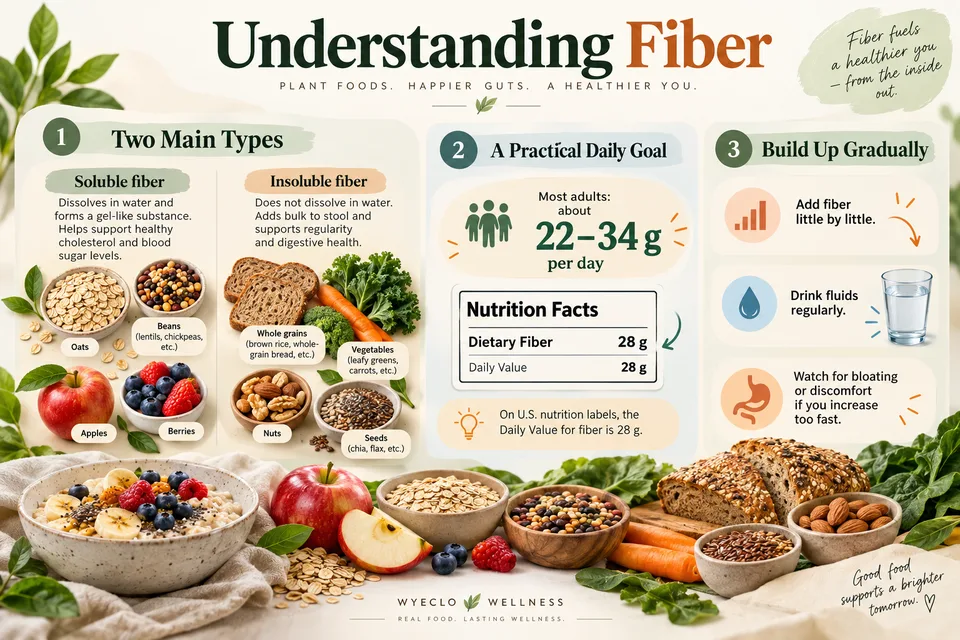
For most people, the simplest approach is not to track two different types of fiber. Eat a variety of plant foods over the week. A pattern that includes lentils or beans, oats or other whole grains, and different fruits and vegetables will generally offer more diversity than a diet based on a single “superfood.”
Can you eat too much fiber?
There is no established universal upper limit for dietary fiber that applies to every healthy adult. But tolerance is real. A sudden jump in intake may bring bloating, gas, abdominal cramps, constipation or loose stools. The risk is particularly relevant if a person changes several meals at once, adds concentrated fiber supplements, or does not take in enough fluids.

University of Utah Health discussed social-media examples promoting 50 grams or more per day in July 2026. That figure is not a universal toxicity threshold: some people may comfortably eat more than others, depending on their diet and circumstances. It does illustrate why “the highest possible number” is a poor personal goal.
Pay attention to symptoms rather than treating discomfort as proof the trend is working. Persistent pain, significant changes in bowel habits or symptoms that interfere with eating merit medical advice.
Who should be cautious before adding a lot of fiber?
People with certain digestive conditions may need tailored advice rather than a generic high-fiber challenge. Depending on the situation, this can include bowel obstruction, active inflammatory bowel disease, recent bowel surgery, a new ostomy, or preparation for a colonoscopy. Recommendations may change as a condition improves; a low-fiber diet is not necessarily permanent.
If you have a diagnosed gastrointestinal condition, recurring pain or a clinician-prescribed diet, ask your healthcare team whether and how to increase fiber. If you take medications and are considering a fiber supplement, check timing and potential interactions with a pharmacist or clinician. Food-first changes are usually easier to personalize, but they are not a substitute for individual care.
A practical way to increase fiber without making every meal a project
1. Start with the meals you already eat
Think about your current routine before adding ingredients. If breakfast is usually toast, try a whole-grain option. If lunch is a salad, add a modest portion of beans or chickpeas. If an afternoon snack is typically a packaged sweet, try fruit with nuts when convenient. You do not need to rebuild the entire menu in one day.
2. Change one or two things—not everything
A large bowl of bran cereal, a bean-heavy lunch, chia pudding and a fiber powder taken on the same day could be a dramatic change for someone used to very little fiber. Choose one repeatable addition, notice how you feel, and increase over several days or weeks. NIDDK specifically recommends introducing fiber little by little so the body can adjust.
3. Drink fluids regularly
Fluids help fiber function comfortably, especially when certain fibers absorb water. The amount you need is individual and depends on activity, climate, food intake and health conditions. If a clinician has told you to limit fluids, follow that advice rather than applying a generic hydration rule.
4. Build from familiar foods
An affordable grocery basket can do much of the work: oats, lentils, black beans, frozen vegetables, berries when available, apples or pears, brown rice, and whole-grain bread. Canned beans can save time; rinsing them may reduce added sodium. Choose options you will actually eat instead of paying a premium for products marketed as a fiber hack.
5. Notice consistency, not perfection
One busy day with fewer vegetables does not erase the value of eating them regularly. If tracking grams helps you learn, use it as a short-term guide. If the tracking itself creates stress, focus on adding a variety of plant foods and paying attention to comfort.
What a higher-fiber day could look like
Breakfast: oatmeal with berries and a small handful of nuts. Lunch: a grain bowl or sandwich with beans, vegetables and a whole-grain component. Snack: a pear or apple, perhaps with nuts. Dinner: lentil soup, a vegetable-filled stir-fry with a whole grain, or another familiar meal with a vegetable and legume side.

This is an example of a balanced pattern, not a fixed meal plan. Exact fiber totals depend on brands, recipes and portion sizes, so it would be misleading to assign one precise number to this entire day. Portion sizes can be adjusted for individual energy needs, appetite, allergies and medical circumstances.
Do fiber supplements count?
Some supplements contain fibers that can be useful for particular goals, but they are not required for everyone. Fiber-rich foods also provide protein, vitamins, minerals and other components that a powder may lack. A supplement can increase intake quickly without helping you develop a varied eating pattern.
If food alone is not enough or you have a specific digestive concern, a registered dietitian or clinician can help determine whether a supplement is appropriate. Follow the product directions and pay attention to fluid recommendations and medication timing.
Common questions about fibermaxxing
Is 50 grams of fiber a day healthier than 28 grams?
Not necessarily. The FDA's 28-gram Daily Value is a food-label reference, and there is no single evidence-backed threshold at which 50 grams becomes better for everyone. People differ in calorie needs, digestive tolerance and medical history. More than you need may add discomfort without a clear added benefit.
Will fibermaxxing make you lose weight?
Fiber-rich foods can contribute to fullness, but weight change depends on many factors. The fibermaxxing label is not an established weight-loss treatment, and a single nutrient cannot guarantee a result. Eating enough food and maintaining a varied diet matter more than chasing a daily fiber record.
Can high fiber cause constipation?
Yes, especially when a sudden increase is poorly tolerated or fluid intake is inadequate. If constipation is persistent or severe, do not keep increasing fiber indefinitely without assessment; the right approach depends on the cause.
Are beans better than fiber gummies?
They serve different purposes. Beans provide fiber along with protein and other nutrients and can form part of meals. A gummy or powder supplies a more isolated ingredient. Neither should be judged from fiber grams alone, and the best choice depends on dietary needs and tolerance.
The takeaway: try fiber-meeting before fibermaxxing
The trend is useful when it reminds people to eat more beans, oats, vegetables, fruit and other fiber-rich foods. It becomes less useful when the goal shifts from nourishment to getting the biggest number on an app.
Start where you are. Make one change that is easy to repeat, give your digestive system time to adapt, and build a varied diet around foods you enjoy. Meeting an appropriate fiber goal consistently is a stronger everyday strategy than trying to “max out” at every meal.
Sources and further reading
U.S. Food and Drug Administration. How to Understand and Use the Nutrition Facts Label (fiber Daily Value: 28 g for a 2,000-calorie diet). https://www.fda.gov/food/nutrition-facts-label/how-understand-and-use-nutrition-facts-label
National Institute of Diabetes and Digestive and Kidney Diseases (NIDDK). Eating, Diet, & Nutrition for Constipation (adult fiber range, gradual increases and fluids). https://www.niddk.nih.gov/health-information/digestive-diseases/constipation/eating-diet-nutrition
University of Utah Health. Fibermaxxing: Can You Have Too Much Fiber? July 2, 2026. https://healthcare.utah.edu/healthfeed/2026/07/fibermaxxing-can-you-have-too-much-fiber
Ohio State Health & Discovery. What’s Fibermaxxing, and Is It Good for You? October 16, 2025. https://health.osu.edu/wellness/exercise-and-nutrition/is-fibermaxxing-good-for-you
ColumbiaDoctors. Is “Fibermaxxing” a Healthy Trend? April 2, 2026. https://www.columbiadoctors.org/node/18701
American Heart Association. 2026 Dietary Guidance to Improve Cardiovascular Health, March 31, 2026. https://professional.heart.org/en/science-news/2026-dietary-guidance-to-improve-cardiovascular-health/top-things-to-know
Your next small step
Do You Really Need 10,000 Steps a Day?
You don't have to chase a perfect number to make walking count. Discover what research says about daily steps and how to build a realistic routine.
Continue reading